About
In northern Pakistan, the ancient route of the Silk Road converged among the mighty Karakoram, Himalayas, and Hindukush ranges, connecting China and Central Asia with the Indo-Pak Subcontinent. For thousands of years, travellers, invaders, missionaries, merchants, pilgrims, and artisans from different cultures entered the region using the legendary Silk Road and its branches. The marks these visitors left on this land can be seen in t rock art, culture, knowledge, and social practices of the region to this day. One of the most fascinating remnants of the meeting of civilizations are the ancient rock carvings found on the boulders and cliffs of the region. The sheer diversity of style and symbolism have marked this area as one of the most important centres of ancient petroglyphs in the world!
In 1978, the 750 km long Karakoram Highway (KKH) was inaugurated, cutting through the Himalaya and Karakoram mountain ranges to connect Pakistan and China, and become the highest paved road in the world. This highway opened a new passage through hilly regions that had been a cultural melting pot for humanity for thousands of years. In 1980, a German scholar, Karl Jettmar and Pakistan’s renowned archaeologist, Professor Ahmed Hassan Dani launched the Pak-German Archaeological Mission to the Northern Areas to systematically investigate the great wealth of ancient rock art in the region, and introduce it to the world.
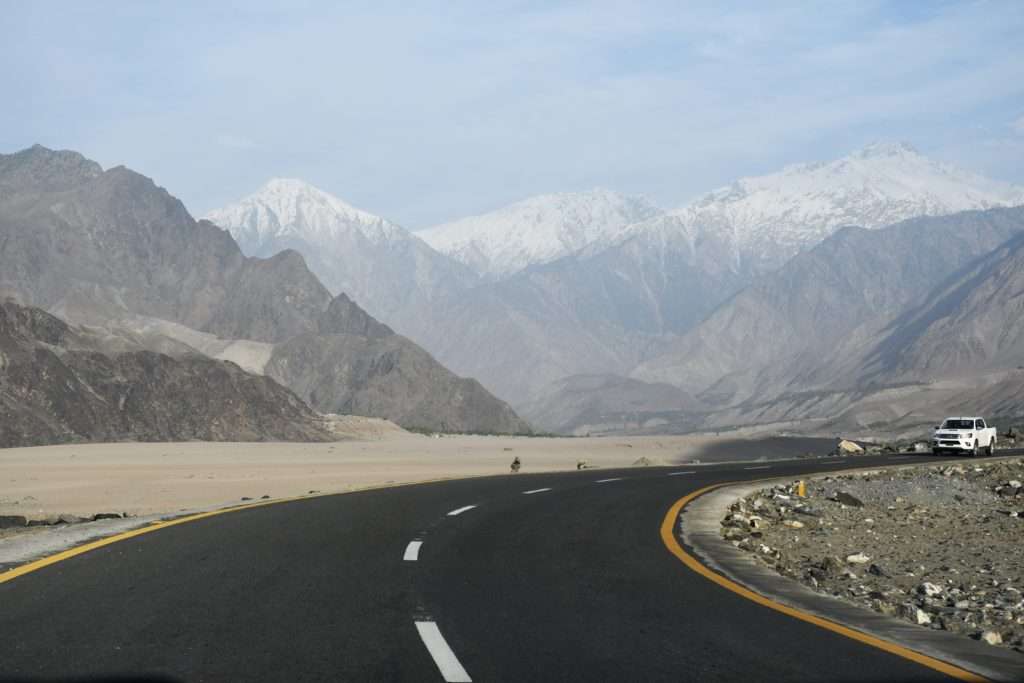
A region spanning approximately 100 km between Shatial and Raikot Bridge on the KKH contains a vast open-air gallery of ancient rock art. More than 50,000 rock carvings and 5,000 inscriptions have been recorded, datable from the 9th century BCE to the 16th century BCE, making some of them nearly 2,900 years old. The carvings show animals, triangular human figures, Buddhist imagery, and hunting scenes – often where the animals are depicted larger than the hunters. The earliest carvings show signs of being carved with stone tools, while the later Buddhist imagery was added using sharp metal tools – a clear indicator of the development of tools and technology in the region.
The ancient scripts include Kharosthi, Brahmi, Sogdian, Chinese, Tibetan, Proto-Sharada, and even ancient Hebrew. A majority of the writings are in the Brahmi script. These inscriptions are a vital source in understanding the religious, social and political situation of the past culture and , communities and visitors to the region. Additionally, some of the inscriptions mention dates and names of rulers, thereby allowing scholars deeper insights into the chronology of the region’s history.
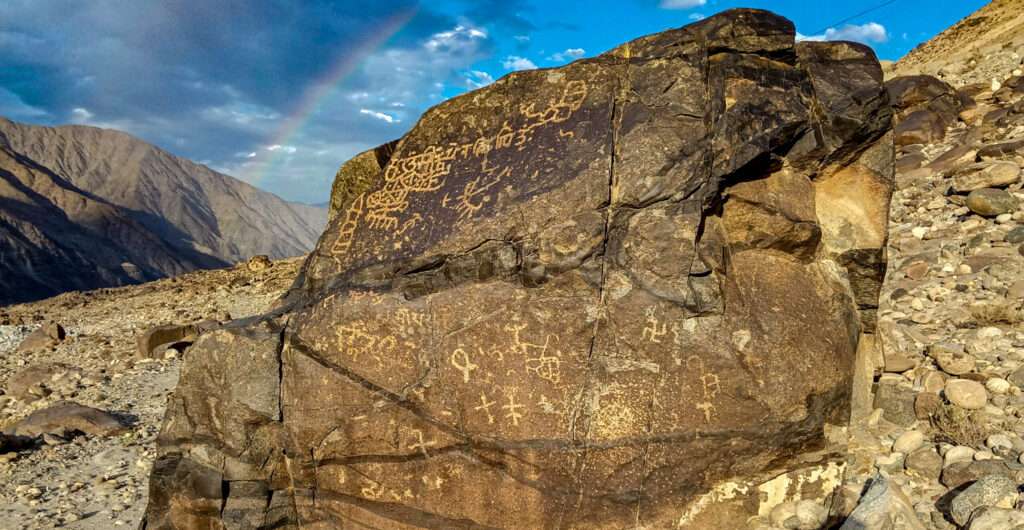
The diversity of the rock carvings is also an indicator of the strategic importance of this region, which compelled so many people – across time and cultures – to make their way through this land. The rock carvings hold within them an entire magnificent chapter of human evolution, and it is time we make a collective effort to understand the stories they are trying to share with the world for thousands of years.